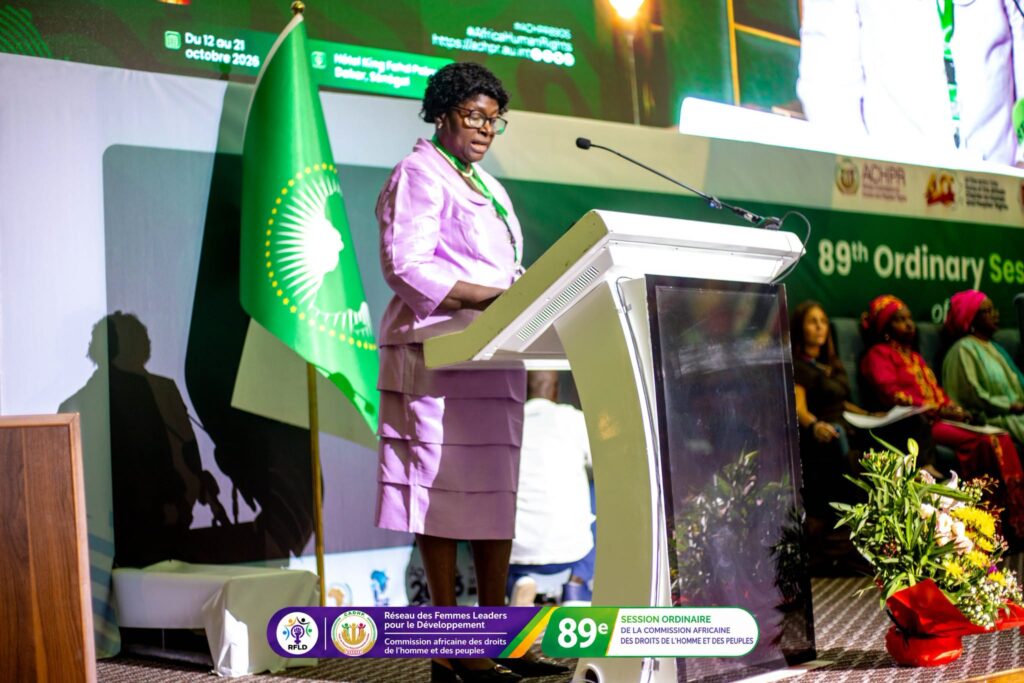
Mrs Hannah Forster, Executive Director of the African Centre for Democracy and Human Rights Studies (ACDHRS), on 12 October 2026 presented the statement of African civil society organisations at the opening of the 89th Ordinary Session of the African Commission on Human and Peoples’ Rights (ACHPR) in Dakar, Senegal, calling on African States and regional institutions to translate human rights commitments into concrete action.
The statement followed three days of deliberations at the Forum of NGOs participating in the 89th Ordinary Session, held from 8 to 10 October 2026 in Dakar under the coordination of ACDHRS. The Forum brought together more than 356 participants from Africa and beyond, representing civil society organisations working across a broad range of human rights and democratic governance issues.
Presenting the collective position of civil society, Mrs Forster conveyed concerns about persistent human rights violations, restrictions on civic space, attacks against human rights defenders and journalists, enforced disappearances, discrimination and barriers to justice across the continent.
As Africa approaches the 40th anniversary of the African Charter on Human and Peoples’ Rights, the statement emphasised that the continent’s principal challenge is no longer simply the development of human rights frameworks, but the effective implementation of existing commitments.
Civil society organisations called for renewed political will, stronger accountability mechanisms and practical measures to ensure that the rights guaranteed under the African Charter are respected and protected in the daily lives of African people.
Protecting civic space and human rights defenders
The statement raised concern over restrictive legislation, arbitrary arrests, surveillance, intimidation and reprisals against civil society organisations and individuals engaged in legitimate human rights work.
Women human rights defenders were identified as particularly vulnerable to gender-based violence, online harassment and other forms of targeted intimidation.
The organisations urged African States to end the criminalisation of legitimate civic activities, guarantee freedom of expression, association and peaceful assembly, and ensure that attacks against human rights defenders and journalists are effectively investigated and those responsible held accountable.
They also called on the African Commission to strengthen its protection mechanisms, respond more effectively to reprisals and intensify monitoring of human rights violations, including cases involving transnational repression.
The statement reaffirmed that civil society is an indispensable partner in democratic accountability, peacebuilding and the protection of fundamental freedoms, rather than an obstacle to governance or development.
Water and sanitation are matters of human dignity
The African Union’s 2026 theme, “Assuring Sustainable Water Availability and Safe Sanitation Systems to Achieve the Goals of Agenda 2063,” featured prominently in the statement.
Civil society organisations stressed that access to safe water and sanitation is fundamentally connected to human dignity, equality, health, environmental justice and sustainable development.
Water insecurity, inadequate sanitation, climate change, flooding, drought and the mismanagement of public resources continue to disproportionately affect women, children, rural populations, displaced persons and historically marginalised communities.
The statement called on States to guarantee equitable access to water and sanitation, prioritise underserved communities, strengthen transparency in public spending and infrastructure development, and ensure that affected populations participate meaningfully in decisions concerning their resources and livelihoods.
It further urged the African Commission to give greater attention to water and sanitation rights in State reporting, thematic work and engagement with national human rights institutions and civil society.
Strengthening democratic governance and preventing conflict
The statement also addressed the relationship between conflict, unconstitutional changes of government, weak institutions and democratic exclusion.
Civil society organisations maintained that sustainable peace requires more than security interventions. It depends on respect for constitutional order, accountable institutions, inclusive political processes, independent justice systems and the protection of fundamental freedoms.
States and relevant African Union institutions were urged to strengthen conflict prevention, address the underlying causes of instability, protect civilians and ensure that security operations comply with human rights obligations.
The organisations also highlighted the importance of addressing structural discrimination, protecting displaced populations, safeguarding communities affected by climate-related crises and confronting the misuse of digital technologies against human rights defenders.
Seven priority areas for action
The statement presented a set of priority calls for the African Commission and Member States, focusing on the protection of civic space and human rights defenders; equitable access to water and sanitation; democratic governance and conflict prevention; combating discrimination and structural exclusion; strengthening protection for women human rights defenders; tackling corruption and improving access to justice; and enhancing regional cooperation and follow-up on human rights commitments.
The organisations called on the African Commission to ensure that the outcomes of the NGOs Forum inform its deliberations and engagement with Member States. They also urged States to respond constructively to civil society submissions, implement the Commission’s recommendations and provide safe and meaningful opportunities for independent organisations to participate in national and regional human rights processes.
From commitments to measurable results
The statement reaffirmed civil society’s commitment to documenting violations, supporting victims and survivors, promoting accountability and working collectively across borders to advance the rights and freedoms of all Africans.
However, the organisations stressed that these efforts must be matched by a clear commitment from States and regional institutions to protect those who speak out against injustice and ensure that human rights mechanisms deliver meaningful results.
As the 89th Ordinary Session continues, the statement places renewed emphasis on the need for the African Commission to stand with communities whose rights remain unprotected and strengthen its role in ensuring that African States fulfil their obligations.
The central message from civil society was unequivocal: Africa does not lack human rights commitments; the urgent challenge is to implement them.
ACDHRS reiterates the call for action, not promises; accountability, not impunity; inclusion, not discrimination; and effective protection, not declarations without implementation.
