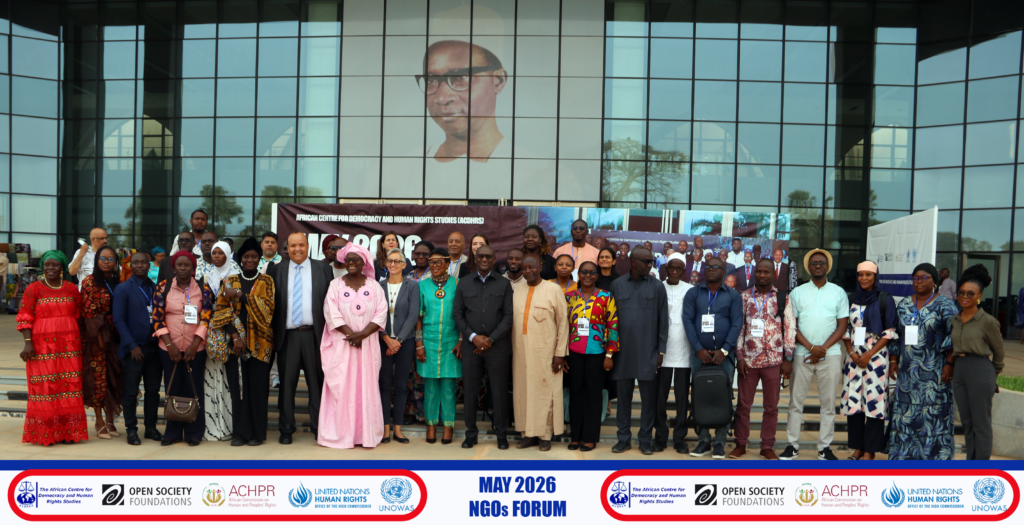
Banjul, The Gambia — The NGOs Forum preceding the 87th Ordinary Session of the African Commission on Human and Peoples’ Rights (ACHPR) concluded in Banjul with renewed calls for stronger protection of human rights, expanded civic space, and greater accountability across Africa.
The three-day gathering, organized by the African Centre for Democracy and Human Rights Studies (ACDHRS), brought together approximately 160 delegates from across Africa and beyond, including civil society organizations, human rights defenders, representatives of regional and international institutions, development partners, and members of the African Commission.
Opening the closing ceremony, Ms. Ellen Ann, Programs Officer of ACDHRS, praised participants for their dedication and emphasized the importance of collective action in advancing Africa’s development and human rights agenda. Quoting an African proverb, she reminded delegates that, “If you want to go fast, go alone, but if you want to go far, go together,” stressing that the aspirations of Agenda 2063 could only be achieved through unity among governments, institutions, civil society organizations, and communities.
“As the curtains slowly fall on this gathering, let us remember that this is not the end of the conversation, but rather the continuation of a shared mission,” she said. “The discussions we held here must now translate into action. Recommendations must become commitments, and commitments must become tangible change for the people and communities we serve.”
In her remarks, Mrs. Hannah Foster, Executive Director of ACDHRS, highlighted the extensive outcomes of the Forum, noting that participants adopted several thematic and country-specific resolutions addressing pressing human rights challenges in countries including Senegal, Tunisia, Zimbabwe, Burkina Faso, Libya, Mali, Cameroon, Chad, and Mauritania.
“We had one inaugural panel and twelve thematic panels which spoke directly to the African Union theme of the year while also examining the wider human rights situation on the continent,” she said. “The discussions and recommendations must now translate into concrete action.”
Speaking on behalf of the Steering Committee of the NGOs Forum, Ms. Melanie Sonhaye Kombate praised participants for their commitment during the intensive deliberations and thanked the Government of The Gambia for once again hosting the Forum.
“We have spent three days examining the state of democracy and human rights in Africa, including issues affecting women, migrants, refugees, internally displaced persons, and communities facing discrimination,” she said. “The commitment of civil society to advancing human rights remains strong.”
Representing the Governing Council of ACDHRS, Mr. Abdelbagi Jibril described the Forum as “a convergence of conscience” dedicated to ensuring that the principles of the African Charter on Human and Peoples’ Rights become a lived reality for all Africans.
“Our discussions addressed shrinking civic space, insecurity, socio-economic inequality, climate injustice, and attacks against human rights defenders,” he said. “The true measure of this Forum will not only be in our discussions but in the actions we take afterward.”
During the ceremony, Mr. Mabassa Fall, Vice Chairperson of the ACDHRS Governing Council, delivered a special tribute introducing Honorable Commissioner Idrissa Sow, Chairperson of the African Commission on Human and Peoples’ Rights. He described Commissioner Sow as a distinguished jurist, scholar, and educator with extensive experience within Senegal’s judicial system and praised his commitment to strengthening African human rights mechanisms and national justice systems.
Mr. Fall noted that Commissioner Sow’s leadership comes at a critical time for the continent, particularly as concerns over shrinking civic space and democratic governance continue to grow. He highlighted the Chairperson’s belief in the importance of aligning national legal systems with African human rights instruments and strengthening collaboration between regional institutions and national actors.
Development partners also emphasized the growing challenges facing the continent. Speaking on behalf of partners, Mr. Jeggan Grey-Johnson of the Open Society Foundation warned that global conflicts and political instability continue to deepen economic hardship and insecurity in Africa, with direct consequences for human rights and democratic governance.
“At a time when conflicts are increasing and civic space continues to shrink, the NGO Forum remains a vital platform that amplifies the voices of African citizens seeking justice and accountability,” he said.
On behalf of the Office of the United Nations High Commissioner for Human Rights (OHCHR), Ms. Catherine de Preux underscored the importance of protecting civic space and supporting human rights defenders working under increasingly hostile conditions.
“Without the ability of civil society actors to organize, advocate freely, and speak out, progress on all other human rights fronts becomes extremely difficult,” she noted. “The resilience and innovation demonstrated by African civil society remain a source of hope.”
Participants also used the closing ceremony to call for greater inclusion and protection of marginalized communities. Delivering the vote of thanks on behalf of participants, Ms. Caroline Kwamboka N. stressed that Africa’s development and renaissance could not be achieved while sections of society remained excluded or invisible.
“We cannot tolerate the invisibility of women’s unpaid labour, marginalized communities, migrants, or people whose sexuality or identity continues to expose them to discrimination,” she said. “The African Charter’s promise of dignity and non-discrimination must apply to every person without exception.”
Closing the Forum, Chairperson of the African Commission on Human and Peoples’ Rights, Hon. Commissioner Idrissa Sow, reaffirmed the Commission’s commitment to strengthening collaboration with civil society organizations and ensuring that the recommendations emerging from the Forum receive due consideration.
“The African human rights system rests on a triangular foundation comprising the Commission, States, National Human Rights Institutions, and civil society organizations,” Commissioner Sow stated. “During my mandate, I will do everything possible to strengthen this collaboration with civil society.”
Commissioner Sow also expressed concern over unconstitutional changes of government, electoral tensions, and violence against African migrants in South Africa. He called for greater political dialogue, transparency, and preventive measures to address crises before they escalate into widespread human rights violations.
The Chairperson further announced that the 88th Ordinary Session of the African Commission on Human and Peoples’ Rights will be held in Senegal.
As the Forum concluded, participants left Banjul with a renewed commitment to continue advocating for justice, accountability, dignity, and inclusive human rights protections across the African continent.
