Forum on the Participation of NGOs in the 87th Ordinary Session of the African Commission on Human and Peoples’ Rights
7 May 2026 – Banjul, The Gambia
OPENING SESSION
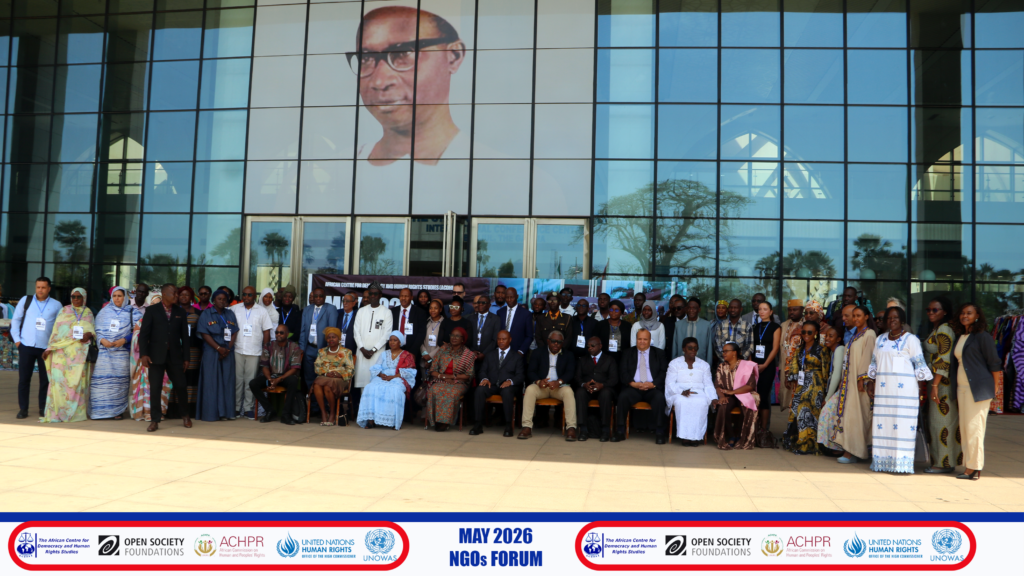
The opening session of the Forum on the Participation of NGOs in the 87th Ordinary Session of the African Commission on Human and Peoples’ Rights (ACHPR) brought together government officials, commissioners, civil society organizations, development partners, journalists, and human rights defenders from across Africa to discuss pressing human rights and development challenges facing the continent.
Opening the forum, the Programmes Officer of the African Centre for Democracy and Human Rights Studies (ACDHRS), Ms. Ellen Ann, stressed the importance of collective action in addressing Africa’s human rights and development challenges, particularly access to safe water and sanitation. “This Forum is more than just a meeting space. It is a platform of solidarity, reflection, accountability, and action,” she said.
Anchoring her remarks on the African Union Theme of the Year 2026, Ms. Ann emphasized that access to water and sanitation must be treated as a fundamental human rights issue. “The theme reminds us that access to water and sanitation is not merely a development issue, but a fundamental human rights issue directly linked to dignity, health, equality, climate resilience, peace, and sustainable development,” she stated.
The Executive Director of ACDHRS, Mrs. Hannah Forster, highlighted the broader political and humanitarian context in which the forum was taking place. She warned that Africa continues to face widespread inequality, insecurity, armed conflicts, displacement, and shrinking civic space. “Our discussions are taking place at a time when Africa continues to face widespread inequity, conflict, displacement, and insecurity,” she said.
Speaking on behalf of the Chair of the ACDHRS Governing Council, Vice Chair Mabassa Fall called for stronger multilateral cooperation and protection of fundamental freedoms across the continent. He warned against increasing unilateralism and growing threats to international peace and cooperation. “We must return to multilateralism, which guarantees peace, stability, and respect for the rights of peoples and nations,” he stated.
Mr. Fall also stressed the importance of protecting freedom of expression, assembly, and peaceful protest, condemning the suppression of demonstrations and detention of protesters in different parts of the world. Addressing the forum’s theme on water and sustainable development, he warned that water insecurity could become a major source of future conflict if not managed cooperatively.
Representing the United Nations Office for West Africa and the Sahel (UNOWAS), Malamin Tamba reaffirmed the organization’s commitment to promoting peacebuilding, good governance, and human rights in the region. “UNOWAS remains committed to working with all stakeholders in the search for preventive solutions to conflicts and crises, while promoting good governance, the rule of law, and respect for human rights in West Africa and the Sahel,” he said.
Mr. Tamba emphasized that water security is directly linked to peace and stability. “In addition to being a fundamental human right, water is also a matter of peace,” he stated. “Unfortunately, it is increasingly becoming a source of competition and confrontation among communities and populations struggling for survival.”
A member of the NGO Forum Steering Committee, Naji Moulay Lahsen, raised concerns over shrinking civic space and increasing repression of activists, journalists, and human rights defenders across Africa. “There is no taboo in this NGOs Forum,” he declared. “Here, we speak truth without fear, hold power accountable, and work toward advancing human dignity across our continent.”
Mr. Lahsen condemned the misuse of anti-terrorism laws to suppress freedoms and criticized the international community’s silence over grave abuses in Sudan and other conflict zones. “The international community’s silence is deafening, and we must not look away,” he said.
Justice Aisatou Jallow of the Superior Courts of The Gambia emphasized that access to clean water and sanitation must be viewed as a matter of justice and human dignity. Speaking on behalf of the Chief Justice of The Gambia, she stated: “This basic human necessity should not be seen merely as a development aspiration. It is at its core a question of justice.”
Justice Jallow also highlighted the judiciary’s role in ensuring accountability and protecting constitutional rights. “Courts serve as vital institutions for accountability, ensuring that public authorities act within the law and that remedies are provided where rights are violated,” she noted.
Representing the Gambian government, Solicitor General Hussein Thomasi reaffirmed The Gambia’s commitment to human rights and sustainable development. “We convene at a critical moment for our continent,” he stated, “one that calls not only for sober reflection on the increasingly severe impacts of climate change and conflicts, but also for a renewed and collective commitment to the shared ideals of solidarity, resilience and human dignity.”
Commissioner Litha Musyimi-Ogana of the African Commission on Human and Peoples’ Rights described the NGOs Forum as an essential pillar of Africa’s human rights system. “The NGOs Forum is not merely a precursor to the sessions of the Commission,” she said. “It is, in many ways, the conscience of our human rights system.”
She further stressed the interconnected nature of water insecurity, governance, and human rights. “These realities remind us that human rights cannot be addressed in isolation,” Commissioner Musyimi stated. “Peace requires justice, development requires inclusion, and rights require participation.”
INAUGURAL PANEL: From Invisibility to Accountability to Secure Sanitation as a Right for Women and Girls in Africa
The inaugural panel of the NGOs Forum focused on the urgent need to strengthen implementation of water and sanitation policies while ensuring that they are grounded in human rights, dignity, and inclusion.
Opening the discussion, moderator Caroline Kwamboka emphasized that Africa’s challenge is not the absence of legal frameworks but weak implementation of existing commitments. “Our deficit lies in the conversion of existing policies into practice,” she stated. “The issue is bringing to life the policies that we already have.”
Commissioner Janet Sallah Njie of the African Commission on Human and Peoples’ Rights framed sanitation as fundamentally a matter of dignity, equality, and justice. “Sanitation is not only about infrastructure,” she said. “It is about dignity. It is about equality. It is about the realization of human rights.”
The Commissioner stressed that inadequate sanitation continues to violate the rights of women and girls across Africa. “When a girl misses school because there is no safe sanitation facility, her rights are violated,” she stated. “When a woman risks assault while searching for a safe place to relieve herself, her rights are violated.”
Commissioner Njie also emphasized that sanitation systems must respond to the lived realities of women and marginalized groups. “Sanitation is not gender neutral,” she stressed. “A toilet without lighting is not safe. A school without menstrual facilities is not inclusive.”
Representing the Nairobi River Commission, Eva Muhia discussed the sanitation crisis facing informal settlements in Nairobi and highlighted the importance of inclusive urban planning. “We shifted the conversation from sanitation as infrastructure to sanitation as a human right,” she explained.
Ms. Muhia criticized the exclusion of women’s experiences from sanitation planning processes. “You can tell many sanitation facilities were not designed from a woman’s perspective,” she remarked.
Raphael Birindwa Rukundanahizi of the Institute for Human Rights and Development in Africa (IHRDA) focused on legal accountability and strategic litigation related to sanitation rights. He stressed that sanitation-related violations can still be litigated under existing human rights protections, including the rights to health, education, and dignity.
Mary Kimemia of IPAS linked sanitation directly to sexual and reproductive health rights. “Water, sanitation and hygiene are not peripheral services,” she stated. “They are foundational enablers of many rights.”
The panel concluded with the formal launch of the Gender, Youth and Social Inclusion Capacity Strengthening Handbook for Water, Sanitation and Hygiene, which participants described as a practical tool for strengthening implementation, accountability, and inclusive policy development across Africa.
PANEL 1: Overview and Update on The Situations of Human Rights and Democracy in Africa Sub-Regional Focal Points Reports
The first panel of the NGOs Forum examined the state of human rights and democracy across Africa’s sub-regions, with speakers warning of increasing authoritarianism, shrinking civic space, attacks on journalists and activists, and worsening humanitarian crises.
Presenting the North Africa report, Naji Moulay Lahsen described a severe deterioration of human rights conditions across the region. He highlighted increasing arrests of journalists, activists, and opposition figures through anti-terrorism and cybercrime laws. “Generation Z movements have become central to civic mobilisation in North Africa,” he noted, especially in Morocco where young activists continue to organize despite intimidation and arrests.
Mr. Lahsen also condemned widespread torture, arbitrary detention, and abuses against migrants and asylum seekers, particularly in Libya and Tunisia.
The Southern Africa report, presented by Cathy Elando Kodiemoka, highlighted concerns over constitutional manipulation, attacks on whistleblowers, and restrictions on civil society organizations. Zimbabwe, Eswatini, and Zambia were cited among countries where governments are increasingly tightening control over political and civic freedoms.
Central Africa Focal Point Mr. Marcel Mani Epee raised alarm over the worsening restriction of civic space across Central Africa, noting that human rights defenders, journalists, activists, and civil society organizations continue to face arbitrary arrests, intimidation, digital surveillance, and violence. He emphasized that the shrinking democratic space in countries across the region poses a serious threat to democracy, peace, and the rule of law, while calling on African states and regional bodies to take urgent action to protect human rights defenders and uphold fundamental freedoms guaranteed under the African Charter on Human and Peoples’ Rights.
Presenting the West Africa report, Melanie N.D. Sonhaye Kombaté described a region struggling with both insecurity and democratic decline. She highlighted worsening violence in the Sahel, restrictions on civic space, and attacks on human rights defenders.
According to the report, Burkina Faso dissolved all political parties, while Mali maintained the suspension of political organizations and civic freedoms. In The Gambia, despite democratic progress since 2017, concerns remain over harassment of journalists, excessive use of force during protests, and attempts to regulate media and social media spaces.
The Eastern and Horn of Africa report, presented by Walda Keza Shaka on behalf of DefendDefenders, documented increasing repression, surveillance, and electoral-related violence across several countries including Sudan, Uganda, Kenya, and Tanzania.
Speakers throughout the panel stressed that shrinking civic space remains one of the greatest threats to democracy and accountability on the continent. Participants called for stronger protection of journalists, activists, youth movements, and civil society organizations working to defend human rights across Africa.
PANEL 2: Access to Safe Drinking Water and Sanitation for Communities Discriminated on the Basis of Work and Descent (CDWD): Between Structural Exclusion, Violation of Dignity, and the Imperative of Social Justice in Africa
The second panel explored how discrimination based on work and descent continues to deny many African communities access to safe drinking water and sanitation.
Moderating the session, Naji Moulaye Lasen emphasized that the panel sought to examine how water and sanitation systems can either perpetuate or dismantle structural discrimination across the continent.
Senior expert on Communities Discriminated on the Basis of Work and Descent (CDWD), Cheikh Sidati Hamadi, stressed that access to water is a recognized human right but remains deeply unequal in many African countries. “These inequalities are not only the result of poverty or geography,” he explained. “They are also shaped by entrenched social structures that systematically exclude communities discriminated on the basis of work and descent.”
Mr. Hamadi presented country examples from Mauritania, Mali, Niger, Burkina Faso, Nigeria, and The Gambia, highlighting severe disparities in access to safe water and sanitation for marginalized communities.
Ali Camara, a CDWD rights expert, shared the lived realities of communities struggling daily for access to clean water. “For many communities, water is something assumed to be available,” he stated. “For us, it is uncertain and often unavailable.”
He explained that the burden of water insecurity falls disproportionately on women and girls who must travel long distances in search of water. “Access to safe water and dignified sanitation is not only about infrastructure,” Mr. Camara said. “It is about equality, dignity, and rights.”
Multidisciplinary artist and advocate Sira Ndongo delivered a powerful intervention linking water access to dignity and justice. “Water does not choose caste,” she declared. “We are not asking, we are demanding justice.”
She further stressed that millions across Africa continue to be denied both water and dignity. “Water for all is not a privilege,” she said. “It is a right and the foundation of life.”
The panel concluded with calls for African governments to strengthen inclusive water governance, produce disaggregated social data, recognize marginalized settlements, and ensure that national WASH policies address structural discrimination affecting excluded communities.
PANEL 3: Customary and traditionalist practices affecting the enjoyment of women’s health, economic, and social rights in Africa
The third panel examined the continued impact of harmful customary and traditional practices on women’s health, economic, and social rights across Africa.
Moderating the discussion, Commissioner Remy Ngoy Lumbu challenged participants to critically examine cultural justifications often used to defend practices such as female genital mutilation (FGM). He stressed that tradition cannot be used to justify violations of women’s dignity and bodily integrity.
Representing the Association of Senegalese Women Lawyers (AJS), Ndeye Fatou Sane discussed the persistence of discriminatory practices affecting women and girls in Senegal. She highlighted barriers to education, land ownership, and economic independence caused by patriarchal traditions and customary systems.
Ms. Sane explained that girls in many rural communities continue to bear the burden of domestic labor, particularly water collection, often at the expense of their education. She also highlighted how discriminatory inheritance systems continue to deny women access to land and economic resources.
Geneviève Séhé Traoré of the Munyu Women’s Association focused on the persistence of female genital mutilation in Burkina Faso despite legal prohibitions. She described FGM as “a grave violation of women’s rights and bodily integrity.”
Ms. Traoré explained that social pressure, fear of exclusion, and deeply rooted cultural beliefs continue to sustain the practice despite awareness campaigns and criminal sanctions. She stressed that legal reforms alone are insufficient without broader social transformation and community engagement.
Representing WiLDAF Mali, Sékou Sidibe highlighted the importance of community sensitization, legal clinics, and partnerships with traditional leaders in combating harmful practices such as FGM and child marriage.
Mr. Sidibe emphasized that while legal frameworks exist, implementation remains weak at the community level. He shared examples of intervention efforts that enabled girls facing forced marriage to continue their education and seek protection.
Throughout the panel, participants repeatedly stressed the gap between legal commitments and social realities. Discussions focused on the need for stronger grassroots advocacy, strategic litigation, community education, and accountability mechanisms to combat gender-based violence and harmful traditional practices.
Ms. Reine Bossa, Executive Director of Association of People Revitalizing Traditional Technologies (APRETECTRA), addressed participants on the widespread but often overlooked issue of economic violence against women in Benin. She expressed gratitude to Lawyers Without Borders and the organizers for providing her with the opportunity to contribute to the discussion.
Speaking on behalf of APRETECTRA, an organization established in 1982 that works across 58 municipalities in Benin, Ms. Bossa explained that economic violence remains one of the most pervasive forms of abuse experienced by women. She noted that depriving women of financial resources strips them of their decision-making power, weakens their ability to defend themselves, and in many cases threatens their survival.
In his concluding remarks, Commissioner Remy Ngoy Lumbu stressed that economic violence against women remains widespread yet insufficiently addressed in many African countries. He encouraged civil society organizations to make greater use of regional accountability mechanisms, including the African Commission on Human and Peoples’ Rights, to pursue justice and strengthen protection for women and girls across the continent.
