The third and final day of the NGO Forum preceding the 87th Ordinary Session of the African Commission on Human and Peoples’ Rights (ACHPR) was marked by robust discussions on shrinking civic space, attacks against human rights defenders, state accountability, democratic governance, and the adoption of thematic and country-specific resolutions. The sessions brought together commissioners, civil society leaders, researchers, journalists, lawyers, healthcare providers, development partners, and regional human rights networks who reflected on the growing challenges facing human rights protection across Africa while reaffirming the importance of solidarity, accountability, and collective action.
Panel 7: Defending Rights in hostile Contexts: Attacks on Human Rights actors advancing Sexual and Reproductive Health and Rights in the Context of Shrinking Civic Space and Gender Backlash”
Panel 7, titled “Defending Rights in Hostile Contexts: Attacks on Human Rights Actors Advancing Sexual and Reproductive Health and Rights in the Context of Shrinking Civic Space and Gender Backlash,” examined the increasing attacks against actors advancing Sexual and Reproductive Health and Rights (SRHR) across Africa. The session was moderated by Honourable Commissioner Janet Ramatoulie Sallah-Njie, Commissioner of the African Commission on Human and Peoples’ Rights (ACHPR).
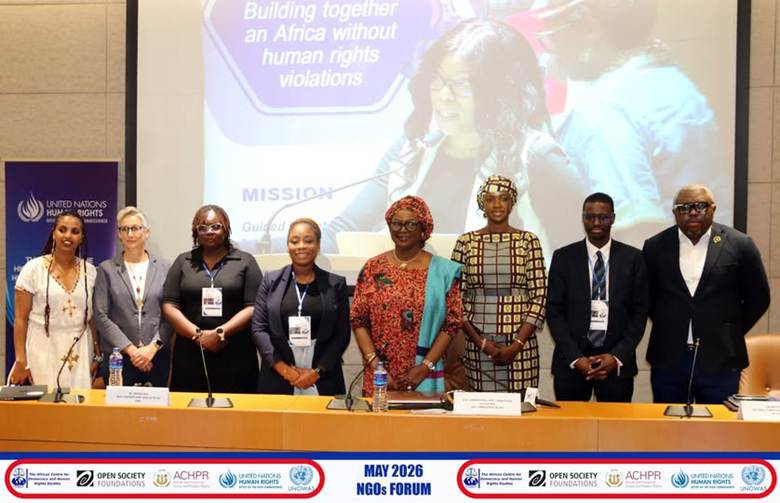
Opening the discussion, Commissioner Sallah-Njie commended the panel for centering lived realities and practical experiences rather than abstract theory. Reflecting on the debates surrounding abortion rights and reproductive healthcare, she challenged prevailing narratives by asking participants to consider the human realities behind restrictive laws and social stigma.
“The question I always ask people is: what if it is your child? Your child is raped. What if your child’s life is at risk? Do you leave the mother to die just because of your faith?”
The Commissioner emphasized that responses to reproductive health issues should prioritize dignity, compassion, and the protection of life. She also highlighted the colonial origins of many laws criminalizing abortion and reproductive health services in African countries.
“Most of the laws that we have today that criminalize are actually not from us. They are actually from our colonizers.”
Commissioner Sallah-Njie further underscored the importance of engaging policymakers directly in advocacy efforts.
“If you don’t lobby parliamentarians, who will you lobby? Because laws are passed in parliament.”
The panel then heard from Nelly Munyasia, Executive Director of the Reproductive Health Network Kenya (RHNK), who shared the realities faced by healthcare providers and reproductive health advocates in Kenya. She described the hostile environment in which providers operate and recounted cases of arrests targeting healthcare workers who provide abortion and post-abortion care.
“The RHNK provider was arrested with the 17-year-old. And this is what happens every day.”
Munyasia warned that misinformation campaigns and anti-rights mobilization continue to place women and girls at risk.
“Women and girls are dying every day because of unsafe abortion.”
She explained that anti-rights actors deliberately spread fear and misinformation targeting healthcare providers and women seeking services.
“They are using abortion to cause disinformation and instilling fear not only to healthcare providers, but also to the women and girls that need these services.”
Despite these challenges, she stressed the importance of building broad coalitions involving researchers, legislators, communities, and religious leaders.
“We have learned that we cannot keep being reactive. We need an ecosystem approach.”
The discussion also featured Dr. Jessica Oga, researcher and human rights advocate, who examined the gendered dimensions of attacks against women human rights defenders. She identified criminalization, strategic litigation, funding restrictions, and emotional intimidation as tactics frequently used to silence SRHR advocates.
“Their goal is not necessarily to win. Their goal is to exhaust you.”
Dr. Oga criticized restrictions on comprehensive sexuality education and highlighted the contradictions faced by girls who are denied both reproductive healthcare and sexuality education.
“You say girls are not supposed to access abortion care, then you also say they should not be taught sexuality. So what are they supposed to do?”
She further emphasized the disconnect between legal protections and lived realities, particularly in conflict and displacement settings.
“We have beautiful laws, but the lived realities of people remain disconnected from those laws.”
From The Gambia, Halimatou Dibba, women’s rights advocate and activist, reflected on the backlash surrounding debates on the Women’s Amendment Act and Female Genital Mutilation (FGM). She described how women human rights defenders faced intense public attacks during parliamentary debates.
“The backlash came not only from lawmakers, but also from religious leaders and public figures.”
Dibba further warned that state silence in the face of harmful rhetoric weakens legal protections and emboldens perpetrators.
Additional interventions came from Mr. Geoffrey Oguaro, civil society representative from Uganda, who warned about growing restrictions on funding and civil society operations, and Halima Tusize, journalist and media practitioner, who emphasized the importance of engaging men and fathers in reproductive health discussions.
Throughout the session, speakers repeatedly stressed the need for stronger solidarity across movements, evidence-based advocacy, proactive engagement with communities and lawmakers, and protection mechanisms for women human rights defenders.
Panel 8: Draft Declaration on the Promotion of the Role of Human and Peoples’ Rights Defenders and their Protection in Africa
Panel 8 focused on the Draft Declaration on the Promotion of the Role of Human and Peoples’ Rights Defenders and their Protection in Africa. The session was led by Honourable Commissioner Remy Ngoy Lumbu, Commissioner of the ACHPR and Special Rapporteur on Human Rights Defenders and Focal Point on Reprisals in Africa.
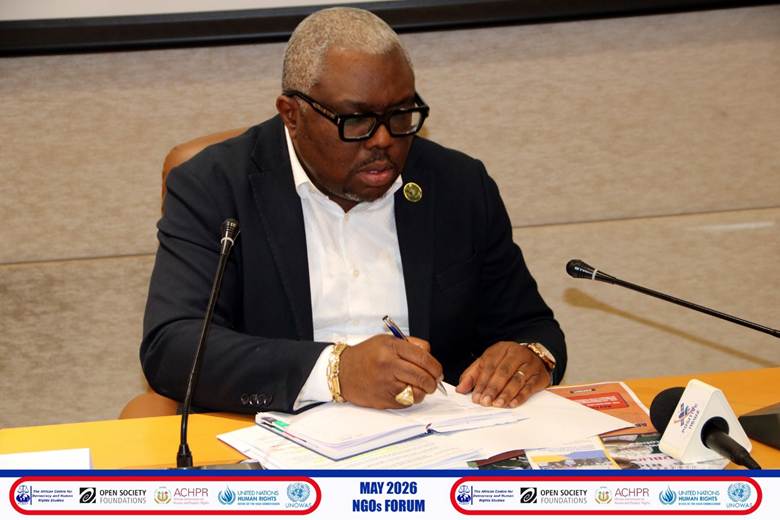
Commissioner Lumbu explained that the initiative sought to develop a uniquely African framework for the protection of human rights defenders grounded in African realities, values, and traditions.
“We have given a certain dose of Africanity to this text.”
He noted that the declaration draws inspiration from the 1998 United Nations Declaration on Human Rights Defenders while adapting the framework to African contexts and traditions.
Participants from regional networks and civil society organizations actively engaged the Commissioner with questions and recommendations. Several participants raised concerns regarding references to “tradition,” cautioning that harmful practices have historically been justified in the name of culture and tradition. Others called for stronger recognition and protection of women human rights defenders and young defenders.
One participant emphasized:
“Women defenders suffer a lot.”
The session also addressed shrinking civic space and the increasing use of restrictive laws, intimidation, and harassment against defenders across Africa. Some participants questioned whether state institutions and security forces should be classified as human rights defenders under the declaration.
In response, Commissioner Lumbu stressed the importance of dialogue as a core African value.
“When you go to the government, go in a spirit of dialogue, not in a spirit of imposing.”
He encouraged participants to submit written recommendations and amendments to strengthen the draft declaration ahead of its anticipated adoption during the ACHPR October session.
Panel 9: Review of State Periodic Reports by the African Commission on Human and Peoples’ Rights: The Role of NGOs
The ninth panel focused on the “Review of State Periodic Reports by the African Commission on Human and Peoples’ Rights: The Role of NGOs.” The discussion was moderated by Dr. Francis Magare, human rights expert and facilitator.
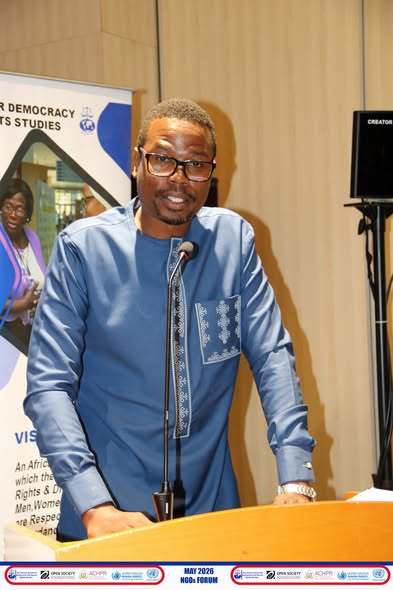
Opening the session, Dr. Magare explained that Article 62 of the African Charter obliges states to report every two years on measures taken to implement human rights protections under the Charter and related instruments.
The first presentation was delivered by Honourable Commissioner Janet Ramatoulie Sallah-Njie, who described state reporting as:
“One of the most important accountability tools that treaty bodies have.”
She emphasized that ratification of treaties alone is insufficient without implementation and reporting.
“There’s no point in ratifying an instrument and then not reporting on it.”
Commissioner Sallah-Njie highlighted the low level of compliance among African states and urged NGOs to engage directly with state delegates attending ACHPR sessions.
“Don’t only run after the Commissioners. Also run after the member states’ delegates and ask them why they have not reported.”
The second presentation was delivered by Dr. Mohamed Benabdoun, human rights expert and legal practitioner, who outlined the role of NGOs before, during, and after the reporting process. He emphasized the importance of shadow reporting and implementation monitoring.
“What’s the point of presenting reports if implementation is not happening on the ground?”
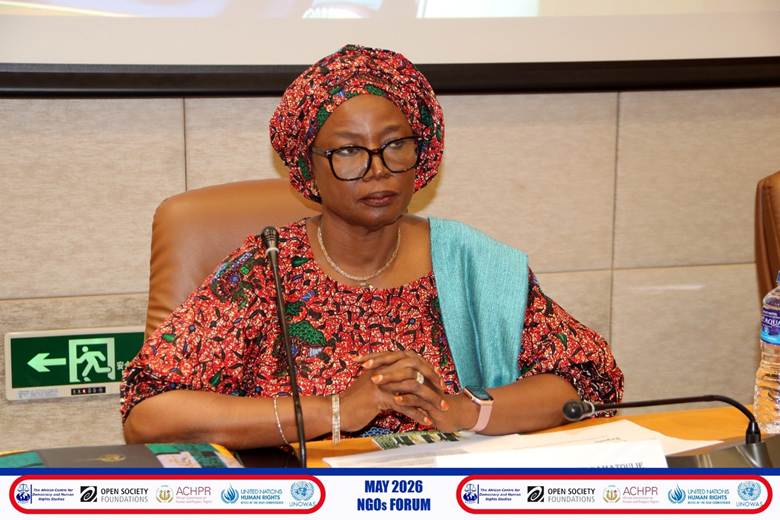
Dr. Benabdoun encouraged civil society organizations to use the ACHPR Guidelines on Shadow Reporting adopted in 2022 to strengthen alternative reporting efforts.
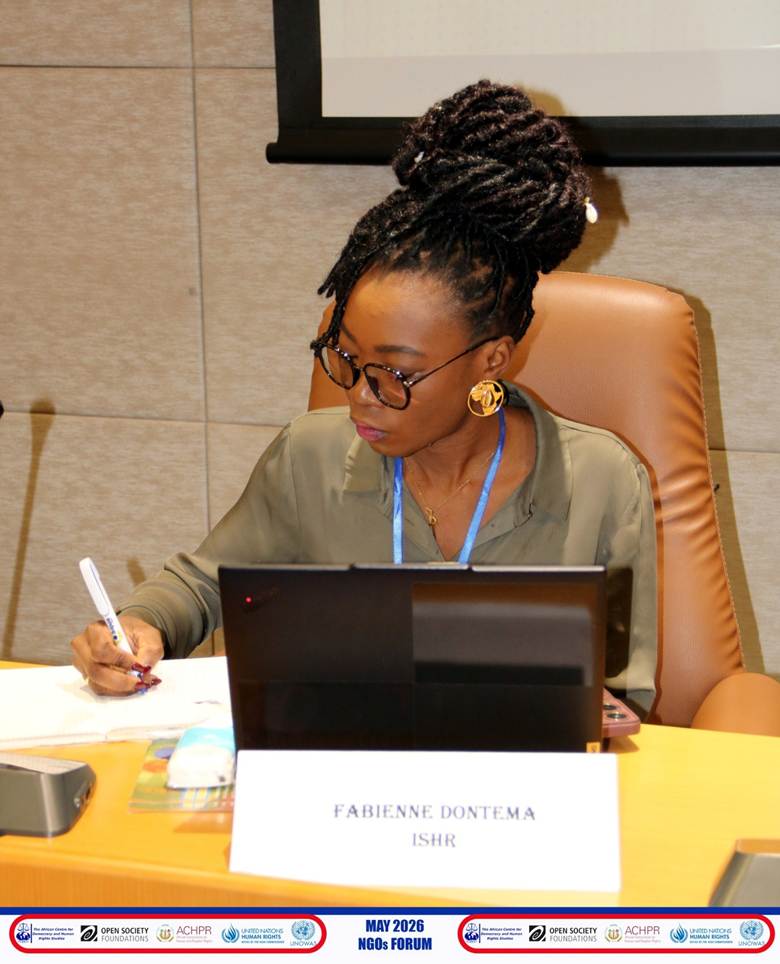
The panel also featured Ms. Fabienne Dontema, representative of the International Service for Human Rights (ISHR), who explained that shadow reports provide critical information often omitted from official state reports.
“We who work on the ground and see what populations actually experience can say: here is the reality the state failed to mention.”
She stressed that alternative reports are essential tools that enable the African Commission to fulfill its mandate effectively.
Participants raised concerns regarding states that continuously fail to report and questioned whether stronger accountability mechanisms should be introduced. Commissioner Sallah-Njie reiterated that the reporting process should also be viewed as an opportunity for states to showcase progress and best practices.
Adoption of Resolutions and Recommendations
The final working session of the NGOs Forum centered on the review and adoption of resolutions and recommendations addressing urgent human rights challenges across Africa. Civil society organizations, human rights defenders, and members of the drafting committee collectively debated, amended, and adopted key recommendations emerging from the three-day Forum.
In total, twelve (12) resolutions and recommendations were adopted, comprising two thematic recommendations and ten resolutions addressing both country-specific and cross-cutting human rights issues. These covered digital rights, elections and democratic participation, shrinking civic space, migration, gender-based violence, protection of human rights defenders, and accountability for abuses.
The Forum first adopted a Recommendation on Digital Rights in Africa, highlighting concerns over internet shutdowns, surveillance, and restrictions on online freedoms. It called for stronger protections for digital rights, ratification of relevant frameworks, and an end to shutdowns during elections and protests. A second thematic recommendation focused on Elections, Civic Space and Democratic Participation, urging states to guarantee free, fair, and inclusive elections while protecting civil society, journalists, and opposition actors from intimidation and violence.
Country-specific resolutions addressed diverse situations. Mauritania was urged to protect activists and migrants and combat slavery by descent. Zimbabwe was called upon to ensure inclusive constitutional reform and end repression. Chad’s resolution focused on accountability for protest-related killings and abuses, while Cameroon was urged to release detainees and address post-election repression and the Anglophone crisis. Tunisia’s resolution condemned shrinking civic space and arbitrary detentions, and Senegal was called to address protest-related abuses, internet shutdowns, and gender-based violence.
A thematic resolution on Sudan, Egypt, and Libya condemned forced displacement and urged respect for refugee protection. South Africa was called to address xenophobic violence, while the DRC resolution focused on sexual and gender-based violence. A final resolution highlighted shrinking civic space and risks facing human rights defenders in Central Africa.
The session concluded with renewed commitments to accountability, democratic governance, and strengthened protection of human rights and civic space across the continent.
Closing Ceremony
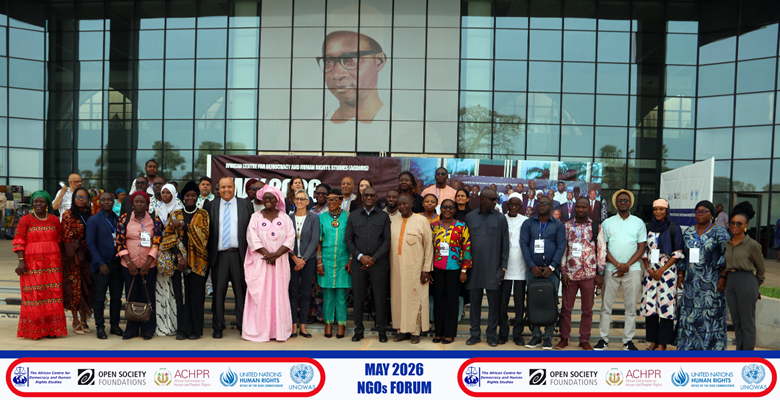
The closing ceremony marked the culmination of three days of intensive dialogue, advocacy, and solidarity.
Opening the ceremony, Ms. Ellen Ann, Programs Officer at the African Centre for Democracy and Human Rights Studies (ACDHRS), emphasized the importance of collective action and unity, quoting the African proverb:
“If you want to go fast, go alone, but if you want to go far, go together.”
She stressed that the recommendations emerging from the Forum must now translate into concrete actions and tangible change across Africa.
The ceremony was chaired by Mrs. Hannah Foster, Executive Director of ACDHRS, who reflected on the successful convening of the Forum and highlighted the adoption of numerous thematic and country-specific resolutions. She noted that approximately 160 delegates from over 25 African countries participated in the Forum.
Delivering remarks on behalf of the Steering Committee, Melanie Sonhaye Kombate reflected on the key issues discussed during the three-day Forum, including access to water and sanitation, shrinking civic space, migration, women’s rights, and unconstitutional changes of government.
Speaking on behalf of the Governing Council of ACDHRS, Mr. Abdelbagi Jibril described civil society as the conscience of the continent and stressed that the real success of the Forum would depend on actions taken after the event.
On behalf of development partners, Mr. Jeggan Grey-Johnson of the Open Society Foundation highlighted the broader global context affecting Africa, including conflicts, economic instability, shrinking civic space, and governance challenges.
Representing the Office of the United Nations High Commissioner for Human Rights (OHCHR), Catherine de Preux emphasized the importance of solidarity, partnerships, and protection of civic space and human rights defenders.
The participants’ vote of thanks was delivered by Caroline Kwamboka N., Trustee and Director of African Renaissance, who emphasized the importance of inclusivity and protection of marginalized communities.
A special tribute introducing the Chairperson of the ACHPR was delivered by Mr. Mabassa Fall, Vice Chairperson of ACDHRS, who praised the leadership and judicial experience of Honourable Commissioner Idrissa Sow, Chairperson of the ACHPR.
In his closing remarks, Commissioner Idrissa Sow reaffirmed the importance of collaboration between the African Commission, states, national human rights institutions, and civil society organizations. He reflected on the significance of the Forum during the 45th anniversary of the African Charter and emphasized the importance of democracy, accountability, and protection of civic space across Africa.
Commissioner Sow concluded by announcing that the 88th Ordinary Session of the African Commission would be held in Senegal before officially declaring the NGO Forum preceding the 87th Ordinary Session of the ACHPR closed.
The final day of the Forum ended with renewed solidarity and collective determination to continue advancing human rights, democratic governance, accountability, and social justice across Africa.
